Tuesday, October 16, 2012

Urban birds fight back

By destroying mulched gardens everywhere:


Note of explanation: This is a male brush turkey. He made that giant pile of litter. He'll guard this pile and move it about as he sees fit. A female turkey may wander by and go "Oh, wow, what a sexy pile of mulch!" Then she'll lay an egg in it, and peace out. No need for incubation. As many of you probably know (especially those that lived through the great mulch fire of 2012), compost piles can get quite warm in the center. The male will continue collecting eggs in this way and be a general asshole to anything that gets near his pile. Then one day a tiny turkey will pop out. Maybe they'll make eye contact. Maybe he will pass a knowing fatherly glance. In all likelihood, he won't even notice and the little fuzzy turkey will wander out on his own into great big world of stuff to scratch.

Monday, October 15, 2012

Urban Birds


DISCLAIMER: The following is purely speculative. The opinions within are only held by me, not other smart scientists.


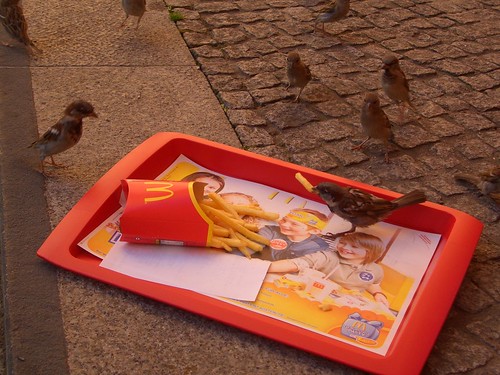
Take a look at the following pictures. Ask yourself, what doesn't belong?


One of these things is not like the other... One of these things just doesn't belong...


Studying conservation biology, I have to often wonder, what actually is out of place here? The bird? Or the people? The buildings? The walls and fences?

Regardless of what should or should not exist in these places, it's all been thrown together now, so what is there to do? How to react?

We often look at these 'urban birds' (I'm going to call them) and think, "Oh, great, they can live in among humans. They are everywhere on campus/in the neighborhood/in the park. They'll be just fine in the long run. These are not the species we need to be concerned with."

But is this true? Is having the ability to live within human society a good thing for an individual? for a species?

A quick google for health benefits of  'green spaces' and 'natural diets' would try to convince you that even for humans, separating yourself from the average western lifestyle improves your overall fitness and well-being. What would make us think that birds that scavenge around a park for discarded french-fries are any healthier than the people whose diet consists of these high-starch, low-protein meals.

As humans, we seem easily tricked that quantity bests quality when it comes to food. We're lured by advertisements for extra value meals, and I at least always seem to have room for the chips piled high on my plate, even when the sandwich was enough. However, eating the extra chips, in a society of excess, doesn't make me healthier.

Could this also be lowering the health of our urban birds? Not enough good stuff, like the seeds they would eat in a natural environment, to go around?

Well this may be OK if only sub-par individuals were living like this. If only individuals that didn't win the competition for the better field/garden/forest territories ended up in the trashcan at McDonald's.

But what if these urban birds, like us, are drawn like a moth to the flame? There's so much food to go around. What if they prefer the suburban lifestyle?  They could stuff themselves silly on the rubbish people toss aside.  Maybe the trash can at McDonald's is the preferred habitat. What if urban birds are flocking to the cities and poisoning themselves on our discards?

Well in that case we may have a problem on our hands.

At this point you should be picturing a big vortex of death with urban birds flying willing into the center.

You may be thinking, "Rach, you're nuts." Or, "What kind of bird would prefer to live in a city? This would never happen."


Enter: House Sparrow


If you know anything about birds or invasive species, you'll know that these guys are not exactly struggling in their world population. Listed as 'least concern' by the IUCN, the house sparrow has become a common resident on virtually every continent. They've been so successful in their colonization because of their omnivorous abilities and their close association to human development. Studies have even indicated that the little finches prefer suburban environments over large green spaces.  

Ironically enough, their populations have started to see a major decline in the last 50 years or so. Now red-listed by the Royal Society for the Protection of Birds in their native UK, house sparrow populations have decreased by over 70% since 1977. One of the possible reasons suggested by the British Trust for Ornithology is "Reduction in the availability of favoured food." 

Could the ubiquitous house sparrow be the passenger pigeon of our era? Disappearing as no one watches.

Something to ponder.


Wednesday, October 10, 2012

Blinded By the Light...


Got a chance to go 'Spotlighting' last night. Here, this is not, as in the US, commonly known as a way for rednecks to hunt deer, but instead a great way to see the huge diversity of nocturnal animals that Australia hosts.

Drove away from Brisbane a bit to the 'Greater Glider Conservation Area'. Oh my gosh, is that a gremlin in the tree? No, just a greater glider!


Other highlights (cough cough... get it?) were common ringtail possums, brushtail possums, and my first wild Koala! We saw one healthy individual, and unfortunately one infected with chlamydia. Don't laugh, it doesn't mean this little guy is slutty or forgot to wear a rubber. This highly communicable bacterial infection has been running rampant around the Queensland Koala population, and has devastated their numbers. Cutting the population down by over 50% in under a decade, this disease is literally threatening the existence of one of Australia's most iconic species. Our naturalist guide for the night reported the diseased Koala, and so hopefully this guy will be brought into custody and treated with antibiotics. 

On a happier note.... look how cute they are! And also the tawny frogmouth (the nocturnal insectivorous bird to the right). Look at his silly frog mouth. Also got a good view of a powerful owl. This is the biggest owl in Australia, and has the biggest range to go with its large size and booming call. So it's lucky to catch a glimpse of this bird at any point in space and on one particular night! 


Also got a chance to see some of the creepy crawlies of the night. Some baby wolf spiders, golden orb weavers, this huntsman spider, and my very first CANE TOAD! There were also some swamp wallabies crashing through the bush. Although probably cute and cuddly like the above animals, I'm listing it here, because it sounds like something from a bad 1940's horror film. 


Australian vocab:

scribbly bark: An australian tree (Eucalyptus haemastoma) as seen at right here. Can't understand why they'd call it scribbly bark...
But seriously, a moth larvae that lives specifically just below the bark of this tree, makes this really cool pattern.


Tuesday, October 2, 2012

Joke of a Science?

Reading an old review paper (Shea 1998) this morning, I came across this. Kind of funny, kind of sad.


"Population management: a joke of a science?
There were four population ecologists shivering and starving, trapped in the boreal winter – a conservation biologist, a fisheries scientist, a theoretical ecologist and a pest manager. A moose appeared on the horizon and came thundering towards them – 1000 kg of warm edible flesh. Each scientist drew on his or her expertise and dealt with the moose using all their respective discipline’s wisdom:
• The conservation biologist couldn’t decide on an objective. He died wondering whether the moose’s existence was more important than his own.
• The fisheries scientist used the wrong model. Based on her prior knowledge of elk, she predicted that more moose would be coming, so she starved in anticipation of a herd that never appeared.
• The theoretical ecologist drew out his laptop and quickly wrote a program to calculate the optimal distance at which to shoot the moose. His calculations proved that the optimal distance was an imaginary number, and he would have been successful had the moose entered imaginary space.
• The pest manager knew immediately that the moose had to be killed – the only question was with what – pesticide or natural biological control? She opted for the environmentally friendly biological control and released a wolf, which turned around and ate her."

Sunday, September 30, 2012

Koala Hugs

It's the Queens Birthday! Happy Birthday! OK... not really. Her birthday's in April. But each 'please-let-me-still-be-associated-with-Britain' country that celebrates this holiday just kind of picks it's own day to do it (usually in early Summer). Queensland, being the exceptional rebel state, decided just this year to skip the traditional May/June celebration date, ignore what the rest of Australia does, and just stick it on October 1st. QLD apparently moved Labor day from March to May this year too, just to confuse it's citizens. Meanwhile, half-way across the pacific, the new gov't, a.k.a. military regime, of Fiji has decided to get rid of Queen's B-day altogether. Good on you, Fiji. But poor poor queen. She doesn't get any attention anymore.

The holiday weather is unfortunately quite wet, but Saturday Gwen and I headed to a Koala Sanctuary (Lone Pine) in Brisbane this weekend for a little personal time with some Australian fauna. As you can see below, koalas and kangaroos are scary and vicious... trying bite and claw...


We also got the opportunity to walk around Oxley Creek commons with Hugh Possingham and his adorable mutt, Douglass. And took the train up to Boondall Wetlands to check out some slightly-less-invaded looking forests. I added 46 birds to my life list... the proportion of which may be skewed just slightly to the walk with Hugh, the professional birder. (OK. 40:6)

Australian vocab:

'Well done' & 'Good on you': a phrase of congratulations or approval. Similar to the western meanings, but can be applied to situations ranging from actual congratulatory situations, to double-fisting red and white wine, to correctly paying the entrance fee to a park.

Wednesday, September 26, 2012

WTF Australia?

So, walking around Australia is something like walking through a US pet store. There are parakeets, cockatoos, zebra finches, iguanas, sugar gliders.... it's kind of silly that half the things we buy as pets come from this one continent. 

All the same, the wildlife in Queensland is pretty cool, and I haven't even walked out of this one suburb! 


Yes, the one is dead, but it's the first marsupial I saw! I've started a short bird list and might start posting it here as I go along. I also saw my first fruit bat flying around last night! 

I'm pretty satisfied with all the new flora and fauna to be seen, but as the following story shows, there are down sides to being on the other side of the world!

My infatuation with all things new and different became tenuous when I realized I hadn't bought any tortilla chips at the grocery store during my first run for staple items. As many of you may know... tortilla chips are a staple for me. I never add them to a shopping list, because when I see them in a store, I automatically restock my cache. You can see how this may have worried me... tortilla chips must not have come into my line of vision while wandering the grocery store! I tried to calm my fear of the worst, but a nagging voice kept whispering... 'maybe there were no tortilla chips'. 

Next trip to the grocery store, I had my priorities set. I first come across the Mexican food section. Filed under 'Asian foods' this section was one shelf of taco kits, a single type of corn tortillas, and a small variety of 'taco sauces' and 'guacamole spices', all which look to have been marketed by Taco Bell. There are 2 pint sized (literally) bags of white corn Mission tortilla chips. A small sigh of relief. But I am confused by their very small size, and more confused that the red label Mission chips next to them are not just the familar triangle shape that the red label usually indicates, but an "extreme cheese" version. WTF?

I again try to convince myself that there must be a whole mass of normally sized and flavored tortilla chips in the regular chip aisle of the store. My shaky confidence quickly dissolved into terror, and shamefully enough almost tears when I found the "Corn chip section":


It is filled with DORITOS!!! Those are NOT tortilla chips. I am devastated. I ended up buying the 2 bags of Mission chips (I did the math, and they are 2/5 the size of a normal bag in the US), as well as 2 other equally tiny bags of a "Deli-style corn chip with sea salt" which have poppy seeds in them and do not taste like tortilla chips (seriously, WTF Australia). So in the end I have spent $8 AU ($8.50 US) on what amounts to be ~ 1.5 bags of sub-par tortilla chips.

It's going to be a long 3 months.


Monday, September 24, 2012

Helllllooooo Brisvegas...


(Brisvegas: actually a slang term for Brisbane, QLD; at least from people in Melbourne)

After two days of trying to not fall asleep in Melbourne, I flew up to Brisbane, where I will be spending the next five weeks at the University of Queensland, St. Lucia. I'll be trying to meet (and get feed back from) a variety of researchers up here. There are so many acronyms associated with this one academic department, I feel like I'm in the US gov't!

EDG - Environmental Decisions Group
CSIRO - Commonwealth Scientific and Industrial Research Organisation
NERP - National Environmental Research Program
ARC - Autralian Research Council
CEED - Centre of Excellence for Environmental Decision Making
GCI - Global Change Institute

... to name a few. And there's surely more I'm missing.

I've gotten a chance to meet with Hugh Possingham yesterday (For those of you not in my field reading this, he's kind of a big deal in conservation biology, particularly systematic conservation planning and decision science). I'm hoping to go out birding with him at some point in the coming weeks. He's does monthly surveys in some locations around here, and has already told me the best place to find a bowerbird within driving distance of Brisie (another slang name for Brisbane)! Heck yes!

I also gave a talk at the departmental morning tea today. There are lots of marine/reef people studying here, so hopefully a few of them know who I am now, and I'll be able to get some feed back on the MPA project I'm doing here.

On a side note, we should have tea and scones in TN once a week! I suppose our equivalent in 2 dollar tuesdays at Sunspot, but tea and scones is so much less committal and more inclusive.

Australian vocab:

"room to swing a cat": refers to amount of space in a particular location/venue. (ex: "Wow there's a lot of people in this pictionary game. There's not enough room to swing a cat in here"). Apparently has actually been tried by at least one native Victorian, resulting in devastating outcomes for the cat.

capsicum: pepper
muesli: granola, or pretty much
flat white: espresso with a ton of milk in it, but not a latte, cause that's also on the menu
brekkie/brekky: breakfast
paw paw: papaya...  that one confused me
mangosteen: mangosteen (yea, ok, it's the same, but it's still the first time I've eaten one!)